
As someone who has spent their career in technology, I’ve often thought about how many things we once believed were science fiction are slowly becoming reality.
When I was younger, shows like Star Trek and Quantum Leap felt magical. The idea of holograms, instant communication, or computers that could talk back to you seemed impossible. If you were born after 2004, you may not realize just how amazed many of us were the first time we saw those ideas come to life.
I still remember when my brother brought home the first iPhone in 2008. I was fascinated by the ingenuity of it. But I also remember covering the speaker with my hand and leaning away from the table when we talked near it.
“It can probably hear us.”
Maybe that reaction came from watching Terminator 2 when I was six. Technology has always carried a sense of wonder—but also a little bit of fear.
So, when the recent wave of artificial intelligence tools began gaining traction, I had the same hesitation. Part of me didn’t want to embrace it. But after enough conversations and presentations about AI, I realized something important:
I needed to get on board.
Before diving in, I asked two simple questions.
First:
How do I actually use tools like ChatGPT?
Second:
How do I stay authentic in the process?
Start With “Why”
The key question isn’t whether you should use AI.
The real question is why.
Why are you doing what you’re doing? What is the result you are trying to achieve?
Every day at work we face tasks that require problem-solving. The responsibility we carry is to understand the objective and determine a creative way to get there. AI can assist with information, ideas, or structure—but if we stop asking why, then we stop contributing value.
And when that happens, our role becomes replaceable.
Know Your Value Add
I remember my first year at Medtronic. I was eager to prove myself and probably worked harder than I needed to. One day, a colleague of mine pulled me aside and said something that stuck with me, “Go home.”
I laughed, but she was serious. Not only did I understand the technical and lean methodologies we were implementing, but I was connecting the team members on the line. When I questioned why someone like my colleague was still a manager (and doing just that – 1980s managing), my manager explained to me: learn from the people around you, but also learn how to bring yourself into the work.
That lesson stayed with me. Technology can support our thinking, but it can’t replace the experiences, perspective, and judgment that we bring to the table.
The Human Touch
If you see me at work, at taekwondo with my daughter, walking on the beach with my family, or cooking dinner at home—you’ll meet the same version of me.
Sometimes my family jokes and tells me to “turn it off.” I usually respond with, “Are you telling me to stop talking?” They usually want me to stop problem solving, stop creating solutions and just be present. But the truth is, I love that we’re called creators. Because creativity is where authenticity lives.
AI can organize data. It can generate images or draft an outline for a presentation. But it can’t replace the moment when you connect with someone in the room.
Maybe it’s cracking a joke about the slide deck AI helped you build.
Maybe it’s asking a colleague how their daughter’s soccer game went.
Those moments are small—but they are human.
And that’s something no algorithm can replicate.
Use the Tool. Keep the Voice.
AI is a powerful tool. It can help simplify information, spark ideas, and make us more efficient.
But authenticity is something only we can preserve.
Use the technology. Learn from it. Let it help you move faster.
Just make sure the voice behind the work is still your own.
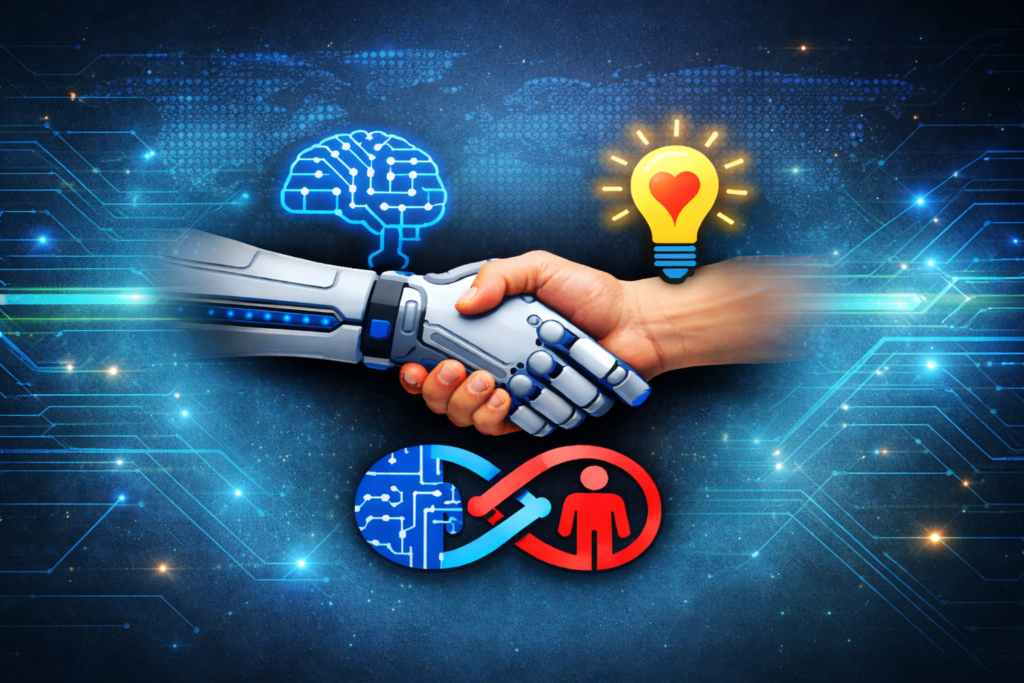
Image created by Open AI – Chat GPT.